How to Document Freight for LTL Shipping

pallet dimensioning shipments pallet dimensioner
Facebook
Twitter
LinkedIn
Print
Email

Proper freight documentation facilitates a smooth shipping process, can help lower costs, and improves your odds of being reimbursed when filing damage claims. The companies that do it best all follow a similar set of procedures, which helps them avoid headaches on the back end. With a little work, any business can implement these best practices and join their ranks.

It All Starts with the Bill of Lading (BOL)

A bill of lading is defined as a contract for the carriage of goods and a document of title to those goods. It contains all the information carriers need to transport your freight to its final destination and should be provided to the carrier upon pickup.

When completed correctly, your bill of lading should include:

• The name and address of the shipper

• The name and address of the consignee (entity responsible for receiving the goods)

• The date of the shipment

• The number of units being shipped

• The declared value of the freight

• Freight classification (NMFC code)

• Weight of the shipment (if multiple units are being shipped, list each weight)

• A description of the goods being shipped

• Packaging type (cartons, pallets, skids, drums, crates, etc.)

• Accurate dimensions (length, width, height)

• PO or other account numbers used for tracking

• A note if the freight is considered a hazardous material (check here)

• Any special instructions for the carrier

Ensure the Accuracy of Shipment Information

As anyone who works in fulfillment knows, the freight preparation process can be hectic, leading to simple mistakes that can be costly down the road. Mistakes when measuring, weighing, or classifying freight can all lead to chargebacks from carriers. And now that most carriers are using automated dimensioning equipment to re-measure and re-weigh more freight than ever, shippers are seeing a greater number of billing adjustments.

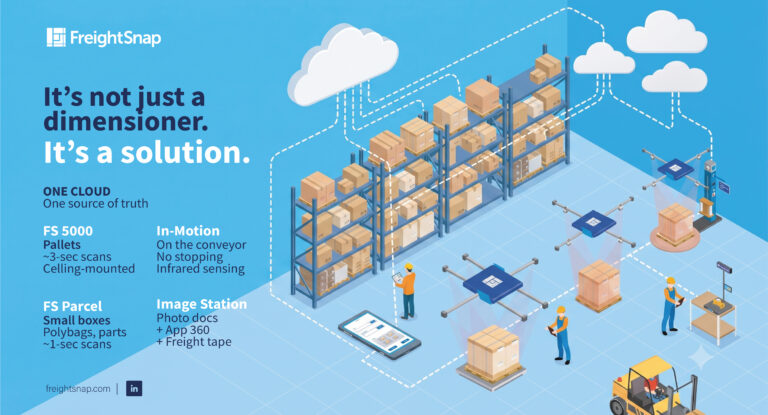
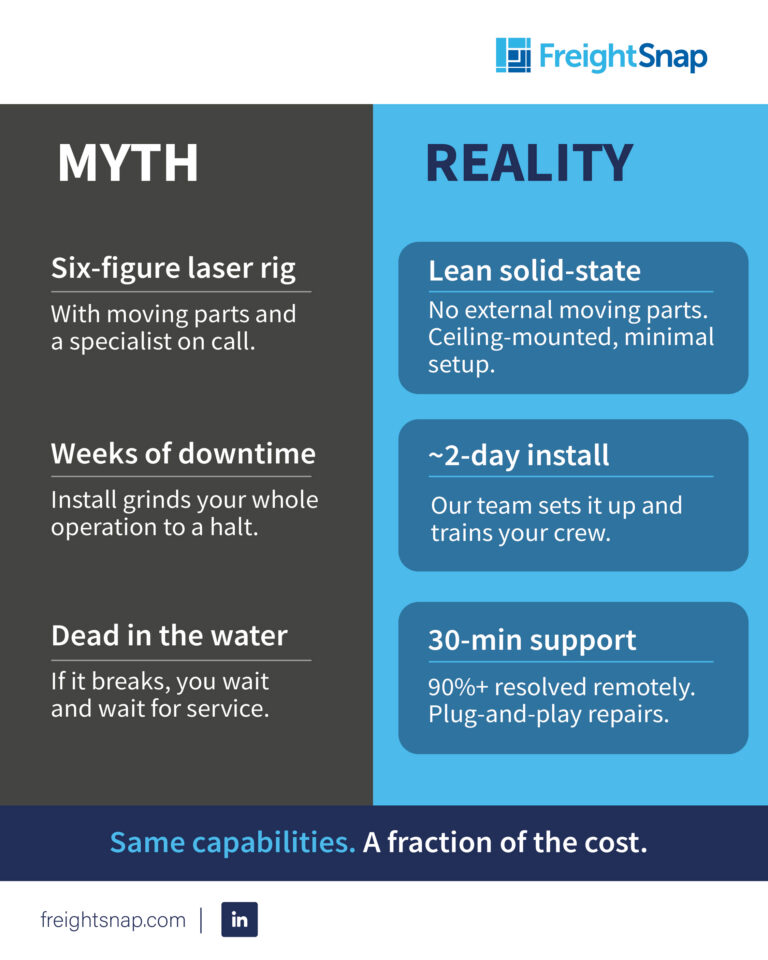
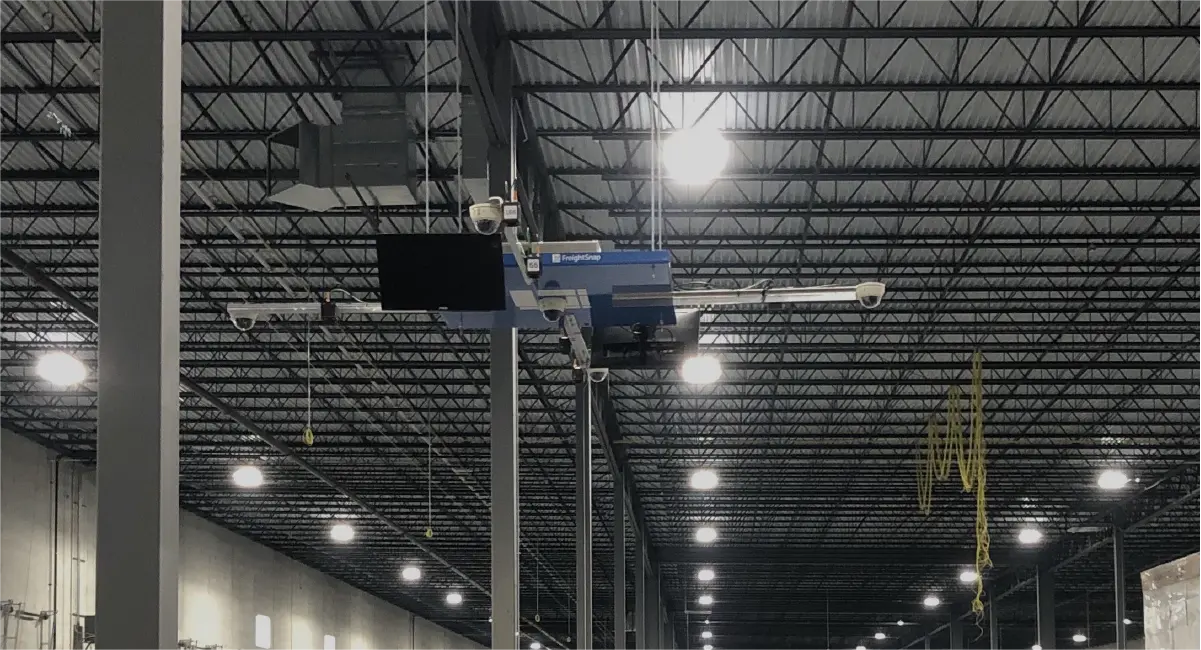
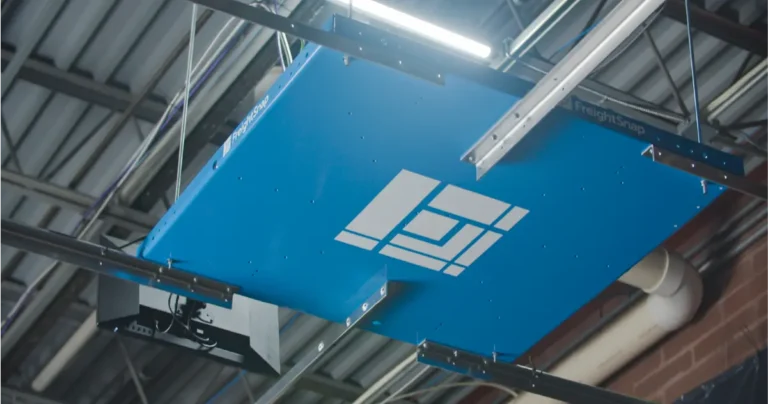
To avoid these adjustments and ensure the accuracy of the information you collect, consider investing in dimensioning and weighing equipment of your own. A 5,000 to 10,000-pound capacity floor scale will only set you back between $500 to $1,500, and is easily worth the investment if you ship more than a handful of pallets each week. Affordable, automated dimensioning equipment can also be purchased, providing you with legal-for-trade measurements and photos of your freight that will not only reduce the number re-classification fees you receive from carriers, but also allow you to refute any re-class fees you do receive with your own verified measurements.

And Speaking of Photos…

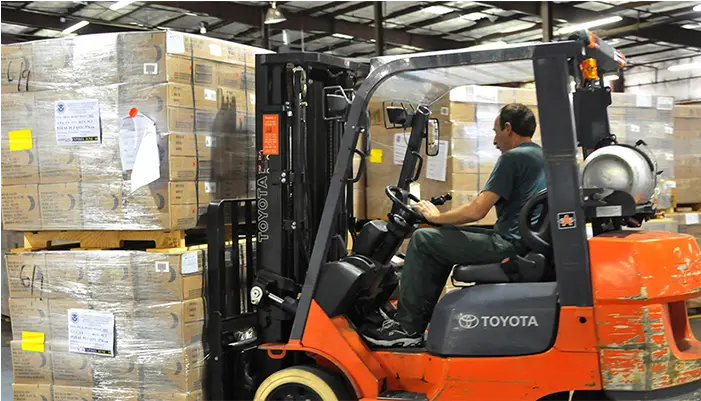
Part of protecting your investment is documenting the condition of your freight before it’s shipped. As mentioned, a dimensioner does this automatically each time a shipment is measured. If you don’t have a dimensioner, or don’t plan to buy one anytime soon, you can also do this manually. Just snap photos of your freight after it has been secured and packed onto the pallet. Show all four sides of the shipment if possible. This way, if your freight is ever damaged or lost during transit, you’ll have proof of its condition, making it much harder for carriers to deny your claim.


For more articles like this, subscribe to our newsletter!

Was this article helpful?

Michael Eichenberg is the co-founder and CEO of FreightSnap, allowing the supply chain, logistics, manufacturing, distribution and transportation industries to measure, weigh, photograph and ID pallets and parcels in just seconds. Learn more and share your ideas on Facebook and LinkedIn.
Subscribe to our Blog

Stay up to date with our latest news, receive exclusive deals, and more.

2023 Newsletter Subscription Contact Form

Subscribe to Our Blog

Stay up to date with our latest news, receive exclusive deals, and more.

Let’s Talk About Drop Shipping In traditional ecommerce businesses, the order fulfillment process involves companies receiving customer orders and shipping the products from inventory they have in stock. This includes picking, packaging, and sending out the order to the customer. Obviously, this method of supply chain management requires significant overhead...

What is Reverse Logistics? Reverse logistics is the process of planning and controlling the flow of goods from the end consumer back to the point of origin – typically the retailer, or even the original manufacturer. Having a well-thought-out, well-implemented process for handling the reverse flow of goods (returned items)...

Ever since volumetric freight dimensioning became the standard form of measurement for the transportation and shipping industries, companies have been working to streamline the process and take advantage of its benefits. But, like any new process, the transition to dimensional weight measurement has caused a few headaches for companies making...

With the ever-increasing speed of technology and the ever-decreasing patience of customers, having accurate freight documentation is a necessity for having a smooth and effective shipping process. However, it can be a slow process and if done incorrectly can cost you time and money. Fortunately, the FS Image Station makes...

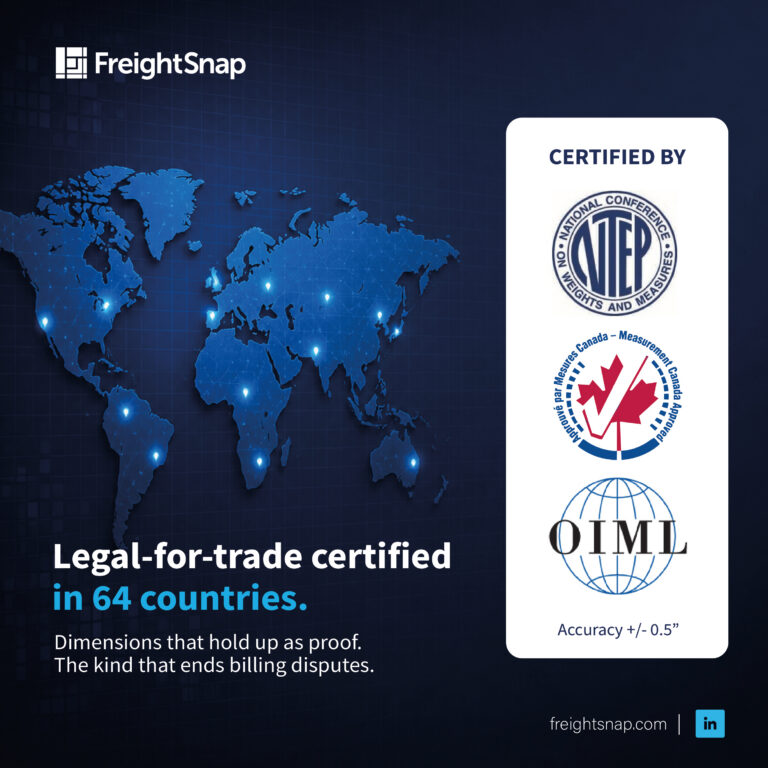
Did you know the FS 5000 is legal-for-trade certified in 64 countries? That’s not a vanity stat. NTEP, OIML, and Measurement Canada certification means your dimensions hold up as proof – the kind that ends billing disputes instead of starting them. Here’s what that certification buys you in the real...

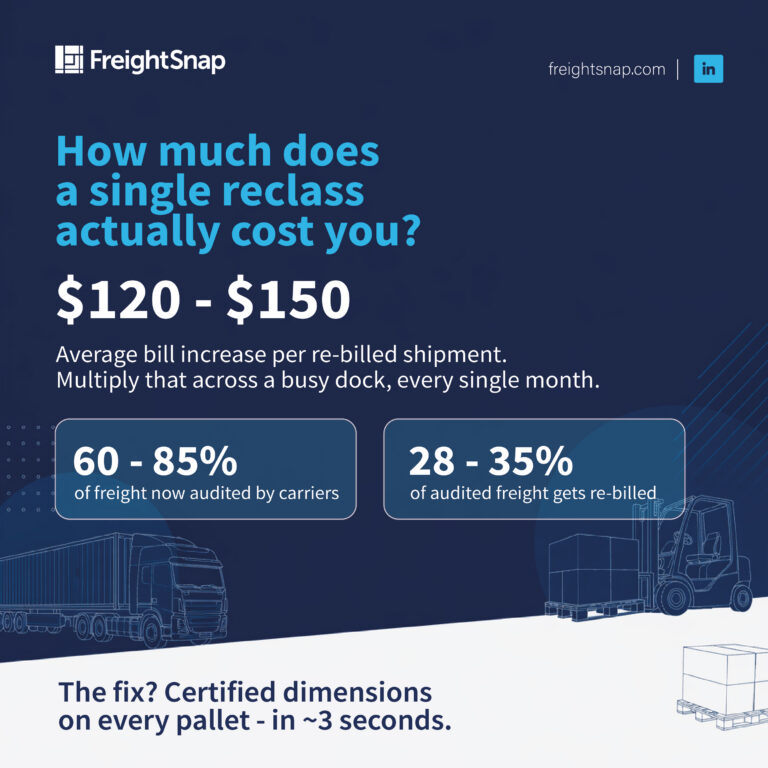
Quick question for the warehouse crowd: how much does a single reclass actually cost you? Because here’s what the numbers say. Carriers now audit 60-85% of freight. Roughly 28-35% of that gets re-billed. And the average increase lands between $120 and $150 per shipment. Multiply that across a busy dock...

“It’s not just a dimensioner, it’s a solution.” That line does a lot of heavy lifting, so let me unpack it. When you bring in a FreightSnap dimensioner, you’re not just measuring boxes. You’re getting a system that: – Protects you from re-bills and quote adjustments with certified dimensions –...

Subscribe to our Blog

Stay up to date with our latest news, receive exclusive deals, and more.

Billions of goods are shipped every day, and nearly all them are shipped on pallets. Foods, fertilizers, chemicals, car parts, children’s toys, tires — virtually anything you can think of — spends part of its life on top of a pallet. And while some organizations estimate that as much as...

Instead of determining shipping rates based on a combination of density, stow-ability, ease of handling and liability – the case under the NMFC’s class based pricing system – LTL carriers in the United States are turning to a simpler way of calculating rates – dimensional-weight pricing. Since the transition began,...

Let’s Talk About Drop Shipping In traditional ecommerce businesses, the order fulfillment process involves companies receiving customer orders and shipping the products from inventory they have in stock. This includes picking, packaging, and sending out the order to the customer. Obviously, this method of supply chain management requires significant overhead...

The American Transportation Research Institute (ATRI) has released its 2018 report on the Cost of Congestion to the Trucking Industry, which showed that congestion caused nearly 1.2 billion hours of delay (the equivalent of 425,533 commercial truck drivers sitting idle for an entire working year) and cost the industry more...

Did you know the FS 5000 is legal-for-trade certified in 64 countries? That’s not a vanity stat. NTEP, OIML, and Measurement Canada certification means your dimensions hold up as proof – the kind that ends billing disputes instead of starting them. Here’s what that certification buys you in the real...

Quick question for the warehouse crowd: how much does a single reclass actually cost you? Because here’s what the numbers say. Carriers now audit 60-85% of freight. Roughly 28-35% of that gets re-billed. And the average increase lands between $120 and $150 per shipment. Multiply that across a busy dock...

“It’s not just a dimensioner, it’s a solution.” That line does a lot of heavy lifting, so let me unpack it. When you bring in a FreightSnap dimensioner, you’re not just measuring boxes. You’re getting a system that: – Protects you from re-bills and quote adjustments with certified dimensions –...

Product Sheet - FS Parcel Dimensioner

2023 DimReimag LP - FSParcel PS Dwnld

Product Sheet - FS 5000 Dimensioner

2023 DimReimag LP - FS500 PS Dwnld

Request a Quote!

2023 DimReimag LP Pricing Request Form