Dimensioning for LTL Carriers: A Quick Look at ROI

Facebook
Twitter
LinkedIn
Print
Email

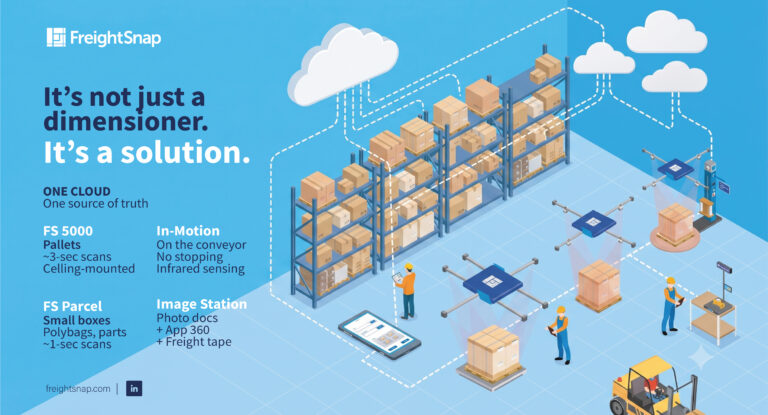
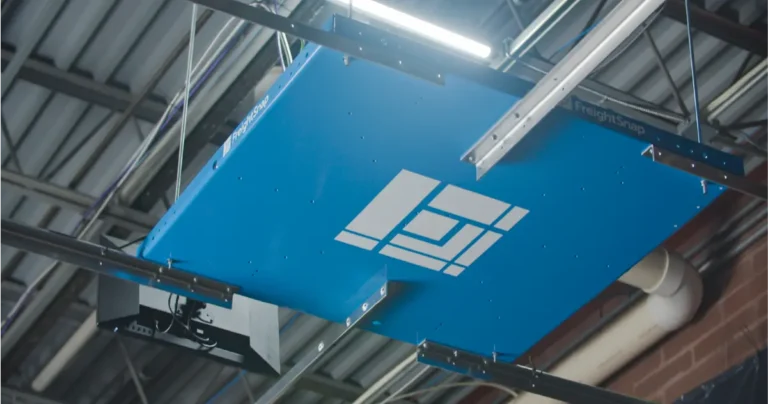
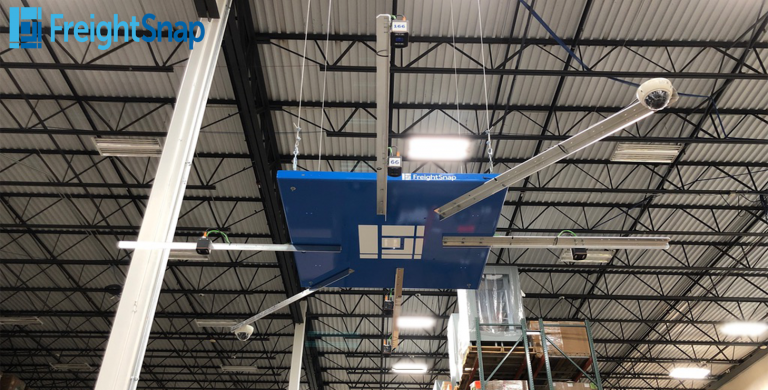
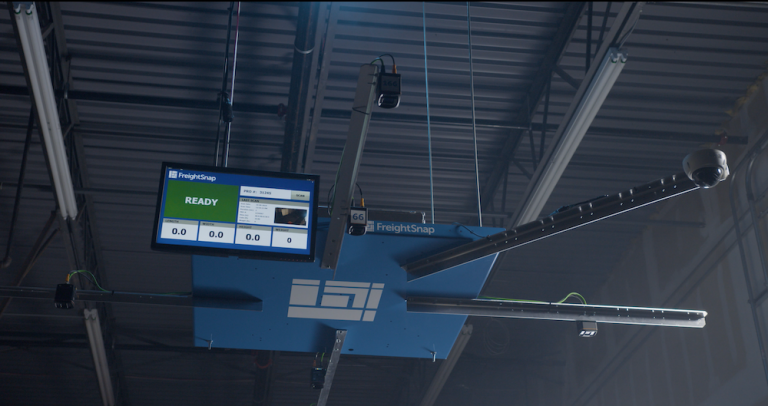
Pallet dimensioners represent a significant capital investment for less-than-truckload carriers looking to bring automated freight measuring into the fold. Even when you consider that dimensioners have come down in price across the board by as much as 60-70% in the last few years, according to a CarrierDirect whitepaper published in 2016, you’re still looking at spending thousands on just one unit. Even our FS 5000 pallet dimensioner, which can be had for roughly a third of the cost of other dimensioners in its class, warrants thoughtful consideration before purchase.

With that in mind, this article will look at the potential return carriers can see when they invest in automated dimensioning equipment of their own.

Millions of shipments flow through less-than-truckload carrier docks each year. And of those, between 20-30% show dimensional exceptions, based on data provided by our carrier clients. What’s more, is that on average, roughly a third of these exceptions can be justly reclassified, meaning that carriers can see additional revenue on between 6-9% of all the freight they measure.

So, let’s say for example that a carrier handles 5,000,000 shipments per year, taking in an average revenue of $225.00 per shipment. Given that carriers can expect to see an additional revenue of 8-12% per re-classed shipment, based on our figures, they’re looking at an additional $18-$27 made per re-class. Multiplying those figures by 6-9% of 5,000,000 (the total number of shipments) and we see that the carrier can expect to make an additional revenue between $5,400,000-$8,100,000 on the low end to $8,100,000-$12,150,000 on the high end. That’s a significant source of previously unrealized revenue no matter how you look at it.

Pallet dimensioners can measure individual pallets in just a few seconds. Yet despite this speed, we’ve seen that one unit installed alone on a cross dock can only measure about 10% of all available freight due to the tight operating windows carriers work in. At a certain point, traffic to and from the dimensioner becomes congested and efficiency begins to wane.

To solve this issue, carriers have taken to installing multiple units across their docks, which decreases congestion and allows them to measure a higher volume of their total available freight.

In some cases, after second and third units have been installed, we’ve not only seen a bump in the total number of shipments measured, but also an improvement in the efficiency of each dimensioner. So, if your goal is to measure a minimum of 20-30% of your freight (the average percentage of shipments showing dimensional exceptions), it would be prudent to look at outfitting your facilities with multiple units.

Freight audits and billing disputes are costly for all parties. Carriers would rather spend less time inspecting freight and processing rebills, and shippers would be happier if audits could be avoided altogether. Dimensioners, when used by both shippers and carriers, foster greater transparency between parties as the measurements and the condition of each shipment can be agreed upon from the beginning of any negotiation.

Additionally, as carriers increase the use of dimensioners in their operations, shippers will inevitably develop new ways to reduce the dimensional footprint of their freight by improving packaging techniques and/or looking for more efficient ways to ship their goods. These innovations will help streamline the shipping process from origin to destination and serve to lower shipping and exception management costs for all parties involved.


For more articles like this, subscribe to our newsletter!

Was this article helpful?

Michael Eichenberg is the co-founder and CEO of FreightSnap, allowing the supply chain, logistics, manufacturing, distribution and transportation industries to measure, weigh, photograph and ID pallets and parcels in just seconds. Learn more and share your ideas on Facebook and LinkedIn.
Subscribe to our Blog

Stay up to date with our latest news, receive exclusive deals, and more.

2023 Newsletter Subscription Contact Form

Subscribe to Our Blog

Stay up to date with our latest news, receive exclusive deals, and more.

By now, we’ve all heard about the shift to density based pricing in the LTL industry. With major carriers like FedEx Ground, UPS, Old Dominion Freight Lines, Estes Express Lines, SAIA and others making the shift, it’s only a matter of time before DIM pricing becomes the norm. And although...

With a new year comes a whole new list of trade shows and expos to get excited about – and FreightSnap will be at a few of the big ones in January and February. First Up – SMC3’s Annual Jump Start Conference (January 22-24, Atlanta, GA) Jump Start gives attendees...

What is Reverse Logistics? Reverse logistics is the process of planning and controlling the flow of goods from the end consumer back to the point of origin – typically the retailer, or even the original manufacturer. Having a well-thought-out, well-implemented process for handling the reverse flow of goods (returned items)...

Shipping and delivery expectations are higher than ever, resulting in busier warehouses, bottlenecked docks, and increased pressure on warehouse workers. Luckily, automated warehouse technology like Dimensioners are becoming increasingly popular and can save time and increase throughput, productivity and accuracy. Purchasing dimensioning equipment can be a confusing process, and it’s...

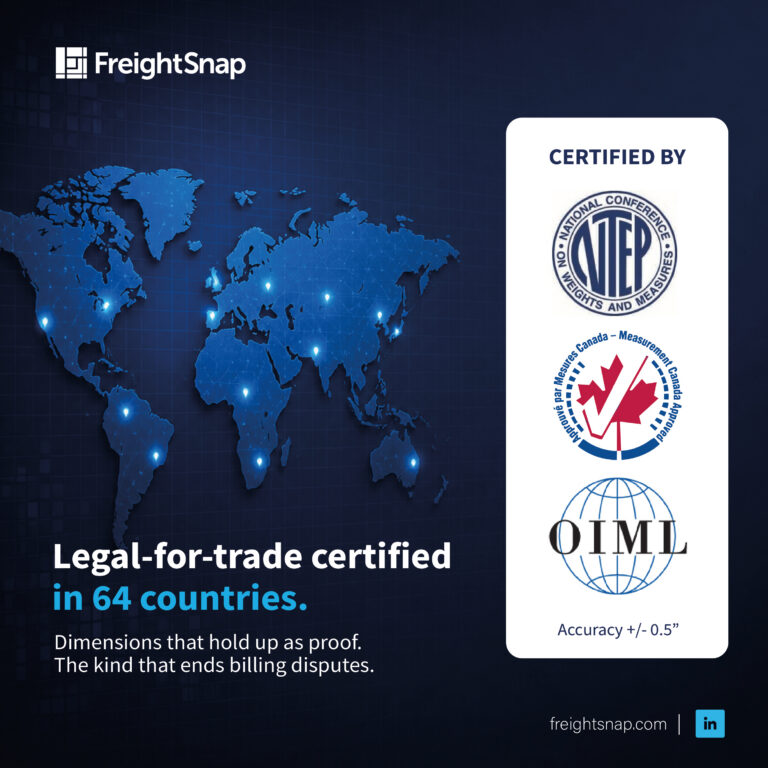
Did you know the FS 5000 is legal-for-trade certified in 64 countries? That’s not a vanity stat. NTEP, OIML, and Measurement Canada certification means your dimensions hold up as proof – the kind that ends billing disputes instead of starting them. Here’s what that certification buys you in the real...

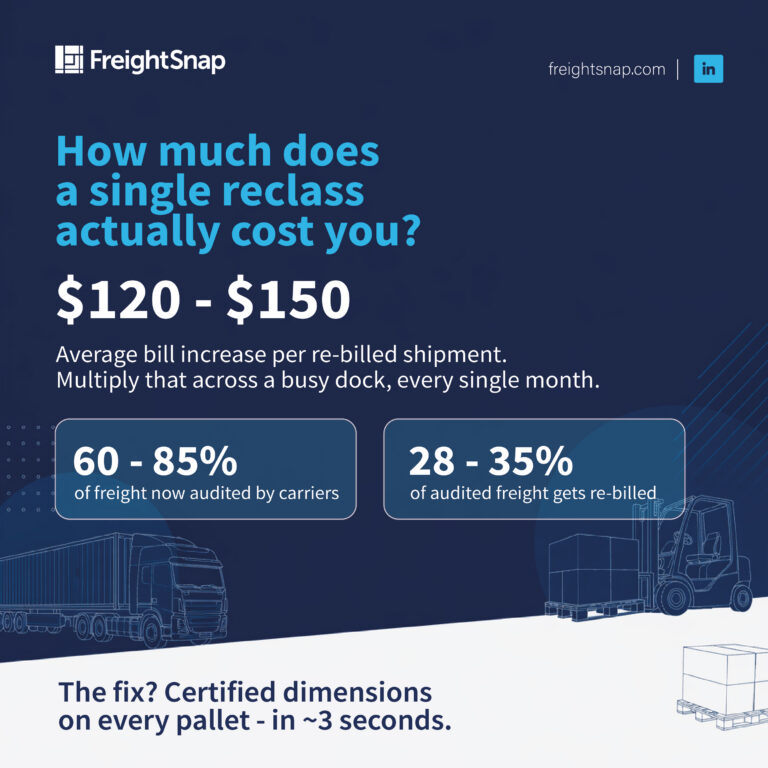
Quick question for the warehouse crowd: how much does a single reclass actually cost you? Because here’s what the numbers say. Carriers now audit 60-85% of freight. Roughly 28-35% of that gets re-billed. And the average increase lands between $120 and $150 per shipment. Multiply that across a busy dock...

“It’s not just a dimensioner, it’s a solution.” That line does a lot of heavy lifting, so let me unpack it. When you bring in a FreightSnap dimensioner, you’re not just measuring boxes. You’re getting a system that: – Protects you from re-bills and quote adjustments with certified dimensions –...

Subscribe to our Blog

Stay up to date with our latest news, receive exclusive deals, and more.

The Importance of Dimensioning Systems In the world of shipping, unexpected costs can quickly spiral out of control, putting a significant dent in your profits. One common source of these unforeseen charges is freight reclassification. But what if there was a way to drastically reduce these costs and improve your...

Let’s talk numbers, because that’s where this gets real. Here’s a real ROI scenario straight from our shippers’ playbook. A shipper moving 220 pallets a month: -> 60% get audited by carriers = 132 pallets -> 30% of those get reclassed = 40 pallets -> At a $130 reclass chargeback...

How you implement a dimensioning program can determine the level of efficiency your program ultimately achieves. Over the years, we’ve seen dozens of companies invest in dimensioning technologies, and truth be told, some have been more successful than others. Why? Most of it can be boiled down to three simple,...

Measuring, weighing and photographing palletized freight by hand can be a time-consuming process that leaves room for measurement and transposition errors. The current generation of static pallet dimensioners have automated this process, allowing companies to capture this information and share it with their resource management systems in a fraction of...

Did you know the FS 5000 is legal-for-trade certified in 64 countries? That’s not a vanity stat. NTEP, OIML, and Measurement Canada certification means your dimensions hold up as proof – the kind that ends billing disputes instead of starting them. Here’s what that certification buys you in the real...

Quick question for the warehouse crowd: how much does a single reclass actually cost you? Because here’s what the numbers say. Carriers now audit 60-85% of freight. Roughly 28-35% of that gets re-billed. And the average increase lands between $120 and $150 per shipment. Multiply that across a busy dock...

“It’s not just a dimensioner, it’s a solution.” That line does a lot of heavy lifting, so let me unpack it. When you bring in a FreightSnap dimensioner, you’re not just measuring boxes. You’re getting a system that: – Protects you from re-bills and quote adjustments with certified dimensions –...

Product Sheet - FS Parcel Dimensioner

2023 DimReimag LP - FSParcel PS Dwnld

Product Sheet - FS 5000 Dimensioner

2023 DimReimag LP - FS500 PS Dwnld

Request a Quote!

2023 DimReimag LP Pricing Request Form