Why Transition to Automatic Freight Dimensioning

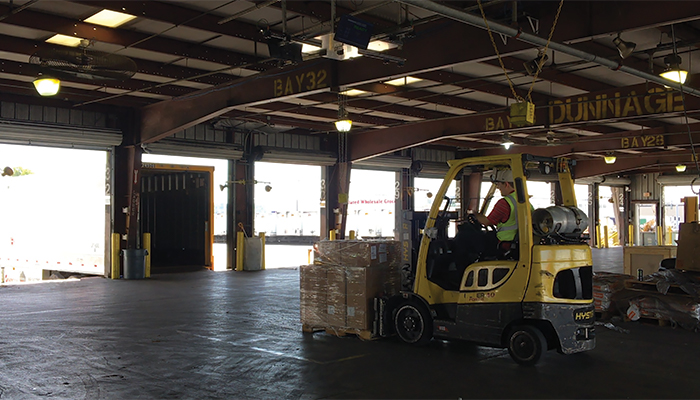
A forklift operator using FreightSnap's FS 5000 pallet dimensioner at a trucking terminal.
Facebook
Twitter
LinkedIn
Print
Email

Ever since volumetric freight dimensioning became the standard form of measurement for the transportation and shipping industries, companies have been working to streamline the process and take advantage of its benefits. But, like any new process, the transition to dimensional weight measurement has caused a few headaches for companies making the change. Take a look at some of the most common challenges companies face, then see how an automatic dimensioner like the FS 5000 from FreightSnap can help you make these issues a thing of the past.

Challenge 1: Measuring Takes Too Long

This one’s a biggie, and it makes sense when you consider that many companies are still measuring freight by hand with a standard tape measure. For small companies that only ship a few packages per a day, it’s generally not an issue, but for businesses that ship or carry thousands of pallets a day, it’s virtually impossible to keep up.

Why automatic dimensioning is the solution?

With an automatic freight dimensioner like the FS 5000, users can find the dimensions of cubic and irregular-shaped freight in seconds — not minutes. So even if takes just two minutes to measure a pallet by hand, and roughly 10 seconds with a dimensioner, over the course of 100 pallets, that’s a savings of 3.25 hours.

Challenge 2: Measurements are Inaccurate

Measuring freight with a tape isn’t only slower, it’s also more difficult to obtain accurate measurements. While a pallet of neatly stacked boxes might not pose a problem, anyone who’s ever worked on a shipping dock knows that “neatly” and “stacked” aren’t words that always go together when talking about freight.

Why automatic dimensioning is the solution?

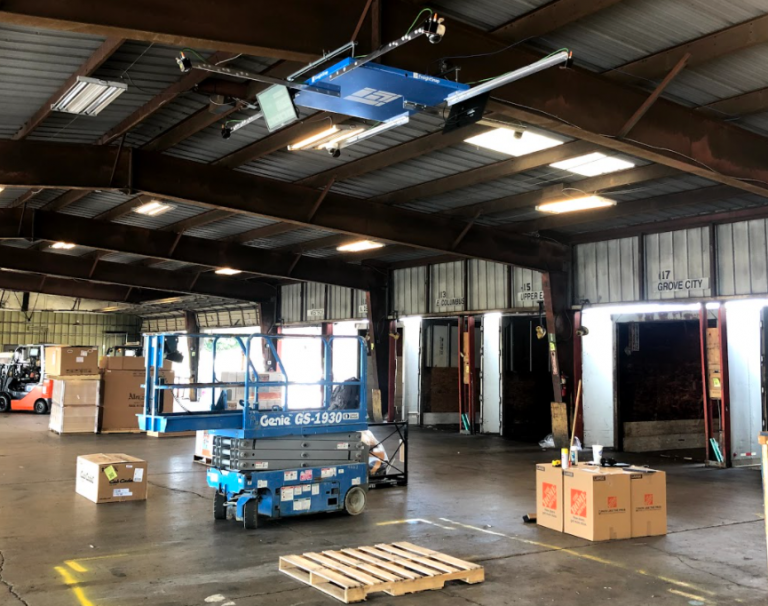
With an automatic dimensioner, it doesn’t matter if you’re measuring boxes or an irregular-shaped object with protrusions. The FS 5000, for example, uses five 3D sensors to capture each protrusion and dimple, which it then factors into the final cubic dimensions provided.

Challenge 3: It’s Difficult to Track, Analyze and Use Data

The major benefit to volumetric dimensioning is its ability to help companies optimize the way they pack shipping containers so they can make more money on each shipment. But, without a good way to record and analyze that data, much of the benefit is lost.

Why automatic dimensioning is the solution?

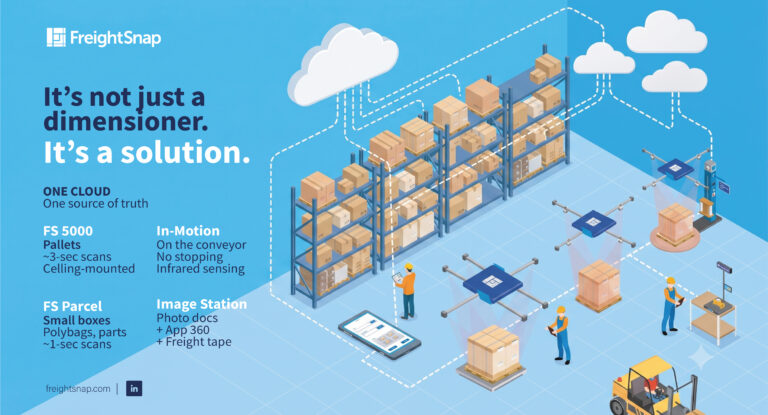
Currently, some dimensioners are better at collecting data than others. With the FS 5000, collecting and delivering data is a focus. After each scan, dimensions and photos of the freight measured are uploaded to the user’s private cloud storage. The data is always accessible and can be used for documentation, to spot trends, and to optimize shipping containers for density.

Are you Ready for Automatic Dimensioning?
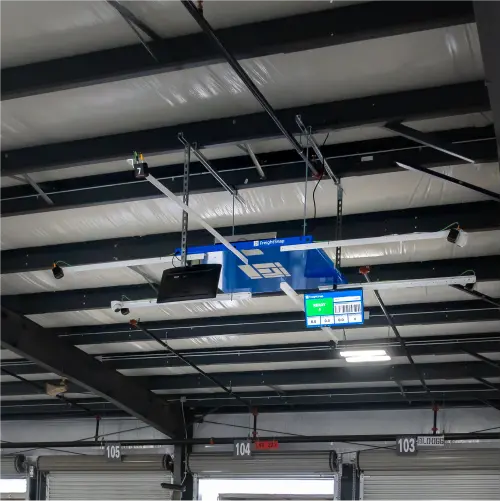
About FS 5000 Pallet Dimensioner - automatic freight dimensioning

For more information about FreightSnap’s automatic freight dimensioner, take a look at our product page. To speak with a FreightSnap representative and see what automatic freight dimensioning can do for your business, contact us and we’ll get back to you soon.

Need More Information About Automatic Dimensioning?

Check out these articles:
 

Subscribe to our Blog

Stay up to date with our latest news, receive exclusive deals, and more.

2023 Newsletter Subscription Contact Form

Subscribe to Our Blog

Stay up to date with our latest news, receive exclusive deals, and more.

Still measuring freight with a tape measure? It’s costing you more than you think. Swipe through the 5 hidden costs of manual dimensioning — and what automation actually fixes. (#4 is the one that sneaks up on people.) The good news: fixing this isn’t the budget-buster everyone assumes. Modern infrared...

What are Pallet Dimensioners Pallet dimensioners, also known as “cubing systems” or simply “dimensioners,” are used by shippers to automate the pallet measurement and documentation process – a process which until recently has consisted of measuring freight with a tape measure, taking a photo of the freight with a digital...

Like many large manufacturers and shippers, Allied Moulded of Bryan, Ohio, determined the importance of adding freight dimensioning to their shipping process. After a careful analysis of freight dimensioning products, they decided to install FreightSnap’s FS 5000 pallet dimensioner. With the FS 5000 now installed, Allied Moulded hopes to see...

Air Distribution, a subsidiary company of Johnson Controls, Inc. was incurring freight reclassifications due to density challenges as well as a much higher rate of lost and damaged freight. The decision was made corporately to run a Pilot program with FreightSnap to better document their freight as it is tendered...

Real talk: FreightSnap started by measuring rooftops. Not freight. Rooftops. Back in 2012, we built software that used Google Earth to measure roofs, yards, and walls for the home improvement crowd. We even landed a U.S. patent on it. Then some logistics folks caught wind of the tech and asked...

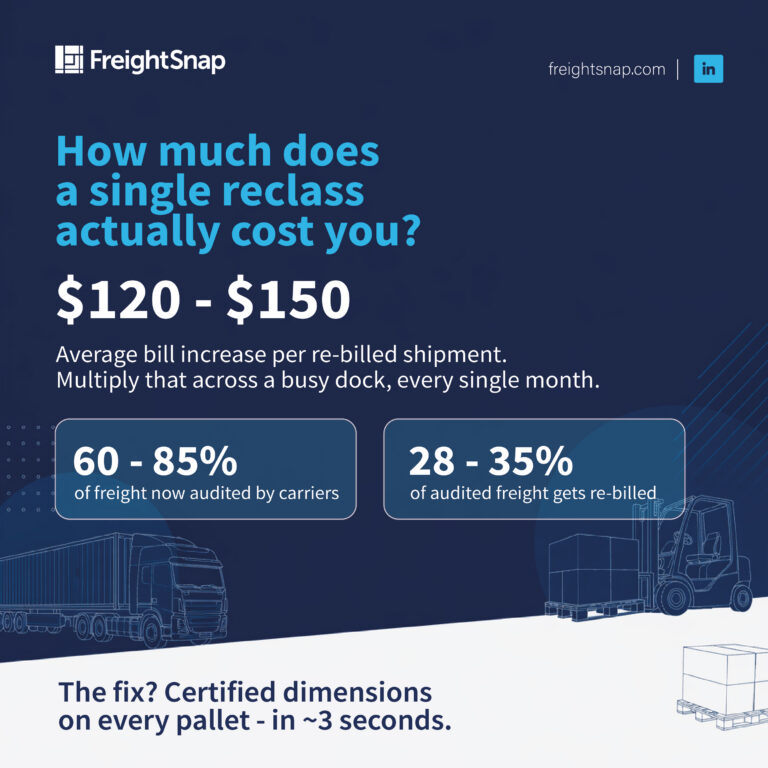
Let’s talk numbers, because that’s where this gets real. Manual freight measuring doesn’t fail loudly. It bleeds you quietly: → Reclassification fees on a single shipment can run hundreds of dollars — and they pile up fast across a busy dock. → Reweigh and re-measure charges hit when your numbers...

Hot take: “Dimensioners are too expensive and too much of a hassle to install” is the most expensive myth in freight. Let’s bust it. MYTH: You need a six-figure laser rig with moving parts and a specialist on speed-dial. REALITY: We build on modern infrared sensors — the same tech...

Subscribe to our Blog

Stay up to date with our latest news, receive exclusive deals, and more.

Any time you add a new piece of equipment or software to your operation, there’s potential for disruption, confusion, and even pushback from employees toward the new device or system. It’s only natural as people don’t like change – especially in the workplace. The good news is, these changes don’t...

LTL shipping can be an efficient way to move freight when it doesn’t make sense to ship a full truckload. But, it’s easy to lose money on costly mistakes if you’re not careful. If you want to see what you might be doing wrong, and avoid potential pitfalls, take a...

The topic of dimensional weight pricing in the LTL transport industry has been covered at length as major LTL carriers like FedEx, UPS, Old Dominion Freight, SAIA, Estes Express Lines, YRC Freight and others have started using DIM weight as a key component in their rate calculations for shippers. In...

In April of 2016, Elegant Lighting Company, a designer and manufacturer of beautiful crystal and modern lighting pieces, chose FreightSnap to help them with their freight dimensioning needs. As a high-volume shipper based in Philadelphia, they needed a dimensioning solution that would help them document and analyze their shipments easily...

Real talk: FreightSnap started by measuring rooftops. Not freight. Rooftops. Back in 2012, we built software that used Google Earth to measure roofs, yards, and walls for the home improvement crowd. We even landed a U.S. patent on it. Then some logistics folks caught wind of the tech and asked...

Let’s talk numbers, because that’s where this gets real. Manual freight measuring doesn’t fail loudly. It bleeds you quietly: → Reclassification fees on a single shipment can run hundreds of dollars — and they pile up fast across a busy dock. → Reweigh and re-measure charges hit when your numbers...

Hot take: “Dimensioners are too expensive and too much of a hassle to install” is the most expensive myth in freight. Let’s bust it. MYTH: You need a six-figure laser rig with moving parts and a specialist on speed-dial. REALITY: We build on modern infrared sensors — the same tech...

Product Sheet - FS Parcel Dimensioner

2023 DimReimag LP - FSParcel PS Dwnld

Product Sheet - FS 5000 Dimensioner

2023 DimReimag LP - FS500 PS Dwnld

Request a Quote!

2023 DimReimag LP Pricing Request Form