5 Tips to Reduce Packaging Waste

Facebook
Twitter
LinkedIn
Print
Email

Companies are always looking for ways to cut costs and run lighter; and reducing packaging waste is one area where many companies can improve. When you reduce packaging waste, in most cases, you’re also shrinking the footprint of your freight, which helps you save space in your warehouse or distribution center, lowers your spend on packing materials, and can even help you save money on shipping – especially now that parcel and LTL carriers are billing more frequently on dimensional weight.

So, what are our tips to help you cut down on waste? Let’s get into it.

We’ve all seen small items packed in large boxes, which in addition to being a waste of materials and money, just looks silly to the end user. Knowing the exact size of your products gives you the information you need to make sure those products end up in the right size box (usually smaller). In low-volume shipping operations where you’re packing fewer than 100 boxes each day, this task can be accomplished by hand with a tape measure or ruler. In higher-volume operations, it pays to invest in an automated dimensioning solution. These systems can measure items in about a second and feed those measurements directly into your warehouse management system where they can be used to optimize packing, storing and sorting within your facility. In addition to creating a faster measuring process, dimensioners also eliminate the possibility of measurement and transposition errors that can crop up when measuring by hand.

Cartonization programs help you determine the optimal way to pack boxes and pallets. They use the length, width and height measurements captured by you or your dimensioner to make sure boxes are filled to their maximum potential given the kind and number of products that need to be accommodated. Obviously, these systems are more useful when they have good measurements to work from, so make sure the measurements you’re collecting are accurate.

If you’re not already using cartonization software of some kind, you could be letting hundreds or thousands of dollars fly out the door each day.

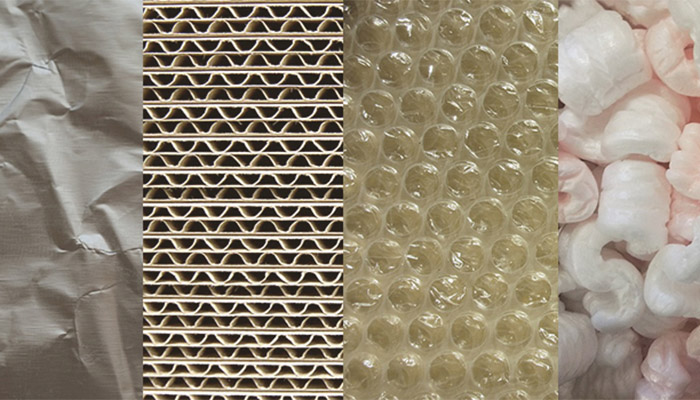
Pallets and boxes that are overstuffed with packing materials and extra padding can be awkwardly shaped and harder to handle, which can actually make them more susceptible to damage than their adequately packed counterparts. When padding out shipments, make sure your product is protected, but don’t overdo it. Choose the right filler for the job, and try to use the minimal amount required for protection.

In the past, single-use, non-recyclable packaging materials were much cheaper on average than their greener counterparts. Today, however, that’s changing. Biodegradable and sustainable packaging solutions are becoming easier to find, and in many cases, are available at or around the same cost as traditional packing materials like Styrofoam packing peanuts and plastic wraps.

Before you order your next round of packaging materials, research sustainable solutions like corrugated bubble wrap, green wrap, biodegradable air pillows and wraps, and even packing peanuts made from corn or other plant starch materials (PSM).

Besides reducing your carbon footprint, using green packaging materials can also pay dividends for your brand. Companies that market their efforts in sustainability, win praise and business from consumers.

Most companies reuse packaging and transport materials to some extent already, but the ones that take it seriously, save the most money year after year. Not only that, but small and large operations alike can benefit. Reusing packaging materials extends the life of those products, reduces the amount of new product you need to buy to replace it, and lowers your waste disposal costs.

That said, every business is different. Some will be able to reuse materials more effectively than others. Companies that control the transportation of their goods (closed transport networks) may find it easier to reuse materials as the materials are easier to track and account for throughout the process. Businesses that utilize multiple suppliers and carriers where goods change hands frequently will find reusing materials more difficult. The key is to identify certain aspects of your operation, or certain facilities where reuse will make a difference, and go from there.


For more articles like this, subscribe to our newsletter!

Was this article helpful?
Subscribe to our Blog

Stay up to date with our latest news, receive exclusive deals, and more.

2023 Newsletter Subscription Contact Form

Subscribe to Our Blog

Stay up to date with our latest news, receive exclusive deals, and more.

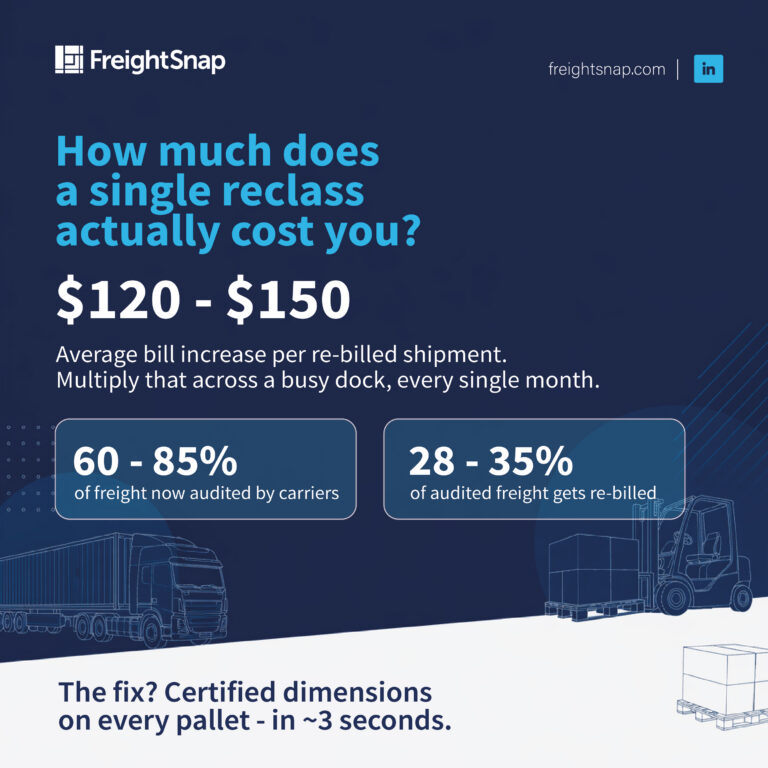
Quick question for the warehouse crowd: how much does a single reclass actually cost you? Because here’s what the numbers say. Carriers now audit 60-85% of freight. Roughly 28-35% of that gets re-billed. And the average increase lands between $120 and $150 per shipment. Multiply that across a busy dock...

The Parcel Industry has changed dramatically in recent years. To keep up with these changes FreightSnap has released the Parcel Flex Dimensioner to help ease some of the pressure for speed and flexibility in ways that can save you time and money. The Parcel Flex is a box dimensioner, able...

The Importance of Dimensioning Systems In the world of shipping, unexpected costs can quickly spiral out of control, putting a significant dent in your profits. One common source of these unforeseen charges is freight reclassification. But what if there was a way to drastically reduce these costs and improve your...

Ever since volumetric freight dimensioning became the standard form of measurement for the transportation and shipping industries, companies have been working to streamline the process and take advantage of its benefits. But, like any new process, the transition to dimensional weight measurement has caused a few headaches for companies making...

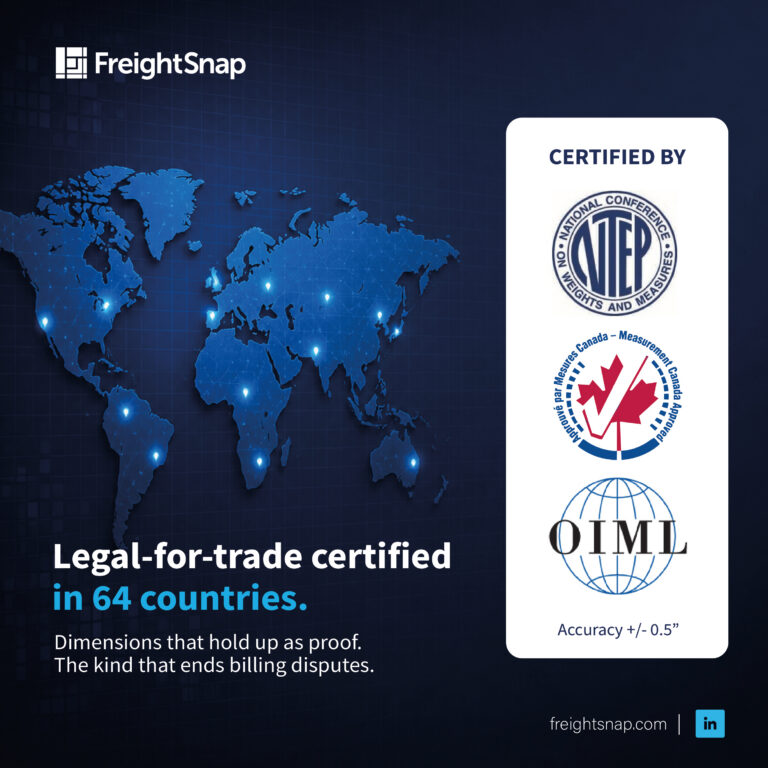
Did you know the FS 5000 is legal-for-trade certified in 64 countries? That’s not a vanity stat. NTEP, OIML, and Measurement Canada certification means your dimensions hold up as proof – the kind that ends billing disputes instead of starting them. Here’s what that certification buys you in the real...

Quick question for the warehouse crowd: how much does a single reclass actually cost you? Because here’s what the numbers say. Carriers now audit 60-85% of freight. Roughly 28-35% of that gets re-billed. And the average increase lands between $120 and $150 per shipment. Multiply that across a busy dock...

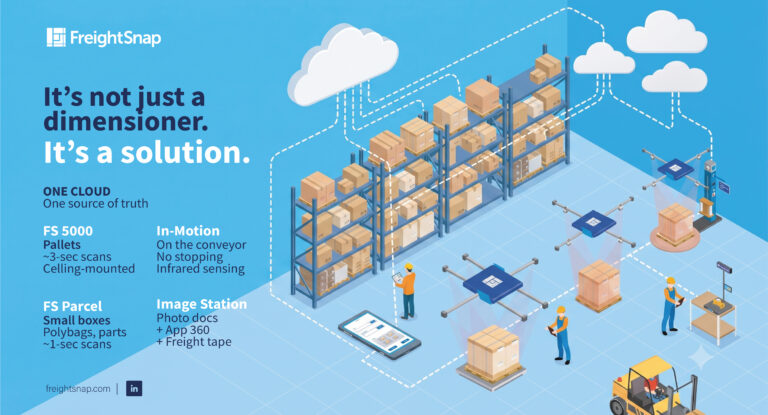
“It’s not just a dimensioner, it’s a solution.” That line does a lot of heavy lifting, so let me unpack it. When you bring in a FreightSnap dimensioner, you’re not just measuring boxes. You’re getting a system that: – Protects you from re-bills and quote adjustments with certified dimensions –...

Subscribe to our Blog

Stay up to date with our latest news, receive exclusive deals, and more.

Liquidity Services is a global company that provides surplus management services to its clients. They refer to themselves as “Reverse Logistics” because they help companies by providing a cash market for surplus inventories. One of the most substantial challenges for the company was handling a massive inflow of inventories. There...

Carriers and shippers might be the most prolific users of parcel and pallet dimensioning equipment, but they aren’t the only ones who can benefit from an automated measuring solution. Recently, freight forwarders have started to jump on board, and they’re seeing benefits they may or may not have planned for....

The topic of dimensional weight pricing in the LTL transport industry has been covered at length as major LTL carriers like FedEx, UPS, Old Dominion Freight, SAIA, Estes Express Lines, YRC Freight and others have started using DIM weight as a key component in their rate calculations for shippers. In...

Your warehouse is busy: From speeding forklifts to shrink-wrapping pallets and the nonstop flow of ticketing systems, it’s hard to know where you can save time and prevent bottlenecks. The pandemic has created an increased reliance on e-commerce fulfillments and has made fast shipping for online orders not only necessary...

Did you know the FS 5000 is legal-for-trade certified in 64 countries? That’s not a vanity stat. NTEP, OIML, and Measurement Canada certification means your dimensions hold up as proof – the kind that ends billing disputes instead of starting them. Here’s what that certification buys you in the real...

Quick question for the warehouse crowd: how much does a single reclass actually cost you? Because here’s what the numbers say. Carriers now audit 60-85% of freight. Roughly 28-35% of that gets re-billed. And the average increase lands between $120 and $150 per shipment. Multiply that across a busy dock...

“It’s not just a dimensioner, it’s a solution.” That line does a lot of heavy lifting, so let me unpack it. When you bring in a FreightSnap dimensioner, you’re not just measuring boxes. You’re getting a system that: – Protects you from re-bills and quote adjustments with certified dimensions –...

Product Sheet - FS Parcel Dimensioner

2023 DimReimag LP - FSParcel PS Dwnld

Product Sheet - FS 5000 Dimensioner

2023 DimReimag LP - FS500 PS Dwnld

Request a Quote!

2023 DimReimag LP Pricing Request Form